
Research delivers safer protected species mitigation for tuna longline fisheries

A five-year project in Australia’s Eastern Tuna and Billfish Fishery has delivered new evidence that protected species mitigation and crew safety can be improved together.
Led by Tuna Australia, the project combined field trials, engineering analysis and controlled flyback simulations to explore how new and improved mitigation technologies can enhance crew safety.
Funded by the Fisheries Research and Development Corporation (FRDC), with support from the Australian Fisheries Management Authority and AMC Search, the project examined line weighting, tori lines, and the testing of flyback bars and screens.
Managing flyback risks
Flyback events occur when hooks are bitten off or lines fail under tension, causing branchlines to recoil toward the crew at high speed.
“Every boat’s got a story of a flyback,” said Jason Boxsell, skipper of Straight Shooter for 4 Seas.
“One of my crew got hit with a lead swivel. Looked like a gunshot wound. Broke three ribs. Punctured his lung.”
Simulations undertaken by the project recorded speeds of hundreds of kilometres per hour, with results showing that weighting and gear configuration can significantly influence risk.
Tuna Australia CEO David Ellis said the project responds to long-standing industry concerns.
“We’ve always been committed to protecting vulnerable species, but some mitigation measures can create unintended workplace health and safety risks for crew,” Ellis said.
This project has given us clear evidence on how to improve safety while maintaining strong environmental performance.”
FRDC’s Toby Piddocke said the research highlights the need for innovation and collaboration.
“Fisheries are facing an unprecedented set of challenges, so we need to drive innovation if we’re going to have profitable and sustainable fisheries in the future,” he said.
“One of the excellent aspects of this research is that it is industry led, with fishers involved as partners or co-investigators.”
Industry testing and on-board experience
Tuna Australia members participated in the project by trialling gear innovations at sea.
4 Seas of Mooloolaba tested flyback bar prototypes, achieving positive results.
“We’ve definitely seen improvements in safety,” said Craig Hansen, General Manager, 4 Seas.
“There’s been less flybacks towards the crew… and a lot less near misses where the swivel comes back near their chest or face.
"It’s safer for them to bring the fish closer to the boat and land the fish.”
Skipper Peter Makiri, FV Esbjorn, said sliding safety leads have made a clear difference on board.
Since we’ve been using sliding safety leads, we’ve seen no flybacks at all, which is a big benefit,” he said.
“The guys feel a lot safer out on deck. With our catch rates, it’s pretty much identical… and bin tangles have gotten better.”
Ellis said the findings support more integrated approaches to fisheries management.
“Mitigation measures must be both effective and practical in real-world fishing conditions.
“This project provides valuable guidance on potentially managing WHS risk, and that safety, sustainability and operational feasibility can be considered together.”
Hear directly from Peter Makiri, Jason Boxsell, and Craig Hansen in these video shorts
Extension materials and industry uptake
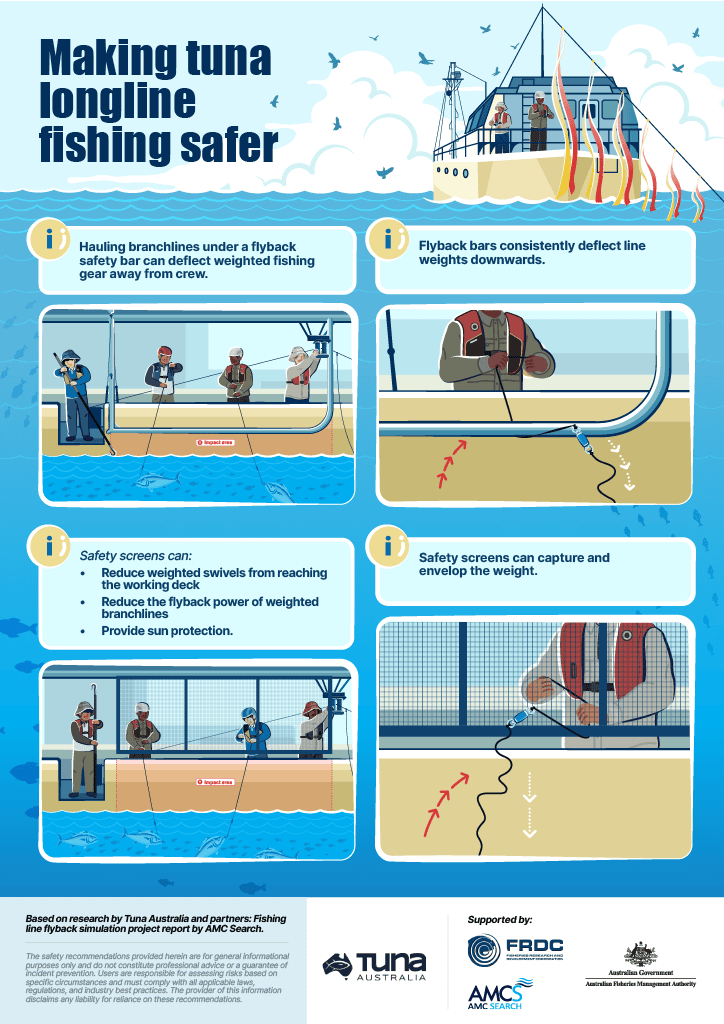
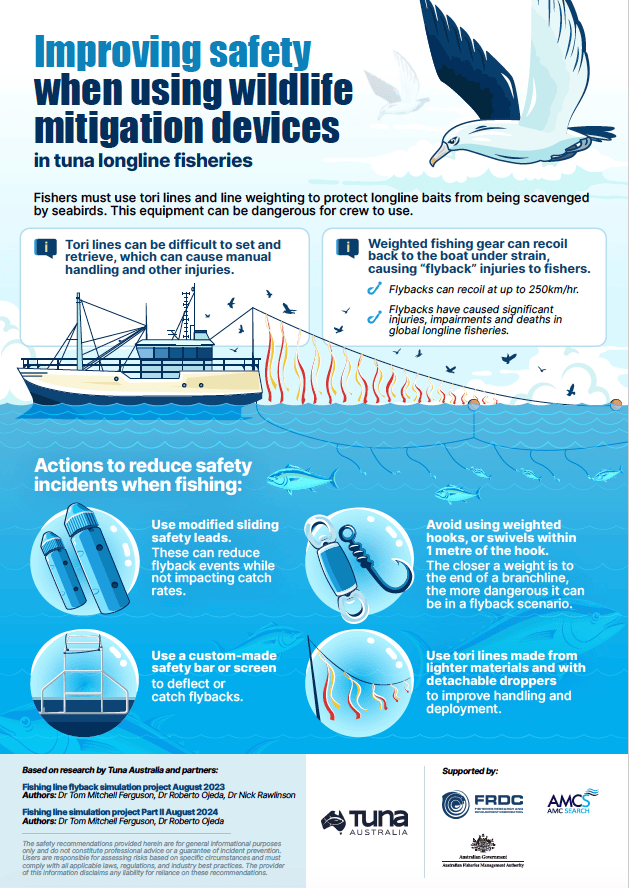
A suite of extension materials has been developed to support uptake of the findings, including short videos and infographics.
These resources translate the research into practical, on-deck guidance for fishers and safety managers.
“These materials will help crews better understand flyback risks and apply safer gear configurations in real-world conditions,” said Ellis.
“They’re also available in Tagalog and Bahasa Indonesia, ensuring they are accessible to all crew.”
The project recommends that future protected species mitigation guidance explicitly consider crew safety alongside conservation outcomes, and that simulation-based testing continue to support evaluation of new tools before widespread adoption.
“The findings provide a pathway toward safer, more effective tuna longline fishing that supports both environmental responsibility and the wellbeing of fishing crews,” said Ellis.
Learn more about the project and access the extension materials: